
New York City Work Safety Violation Lawyers
Attorneys Discuss Workplace Safety Violations in NYC
In the U.S. every year, almost four million workers suffer injuries on the job, and on average 12 people head off to work every day and do not come home. It is the employer’s responsibility to contact OSHA whenever a worker is injured on the job for all companies, regardless of the number of employees they have. As an employee, you should notify your employer as soon as possible after suffering an injury in a work accident. The injury should be reported in writing, and you should maintain a copy for your records. Also, you need to file your claim for workers' compensation immediately. The sooner this is done, the sooner your workers' compensation benefits can start.
Contact a New York work safety attorney who has workers' compensation experience to get the best results. Call (212) 986-7353 to discuss your case during a free consultation.
Common Unsafe Working Conditions
It is the employer’s responsibility to provide a safe and healthy working environment for all workers. Unfortunately, employers frequently cut corners by not requiring supervisors to take the necessary precautions to eliminate common workplace hazards. Types of unsafe conditions that should be eliminated by employers include:
- Toxic fumes
- Exposure to loud noises
- Broken equipment or tools
- Poor lighting
- Unsanitary conditions
- Wet and slippery floors
- Unsecured heavy equipment
- Insufficient safety equipment
- Unremoved objects on the floor
- Reckless placement of toxic chemicals
- Exposed wires, frayed cords, faulty wiring
Federal and New York State Alliance
Together, the U.S. Department of Labor's Occupational Health and Safety Administration (OSHA) and the New York State Workers' Compensation Board (NYSWCB) have formed an alliance to provide guidance, information, and access to training resources to protect the health and safety of New York workers. The New York State plan’s goals include the following:
- In order to identify job-site health and safety hazards, OSHA and NYSWCB will work together to provide education programs using hazard analysis techniques.
- The two agencies will work together to recognize and prevent job-site hazards and provide information on workers' compensation.
Ten OSHA Standards Most Often Violated
OSHA's job is simple: it is an organization tasked with promoting safety in the workplace. OSHA enforces safe work environments through inspections and by providing information and education for workers and employers. Considering how many workers there are in this country, however, it is impossible for OSHA to have a presence on every job site.
When OSHA is called in to perform an inspection, they find the same violations over and over again. These standards violations are not only common, but dangerous. If employers strictly enforced these safety standards, many workplace injuries and deaths could be avoided.
The top ten health and safety standards violated include the following:
- Use of fall protection: Although fall protection requirements are clear, they are often ignored. Experienced workers may feel they do not need such protection, and new workers might not be properly trained in how to work safely at heights.
- Communication of hazards present: Paper documentation and proper training is required to keep workers safe around hazardous materials. When workers do not know the dangers of a worksite, they cannot take actions to stay safe.
- Scaffolding requirements: This includes rules about the height and construction of scaffolds, where they can be placed and supported, and how often they must be maintained. Falls and other serious accidents often occur due to unsafe scaffolds.
- General industry respiratory protection: Few forms of protection are as important as respirators in toxic environments. The long-term effects of lack of respiratory protection include lung disease, heart disease, and cancer.
- Control of dangerous energy: Proper lockout/tagout procedures must be followed to keep workers from being injured while equipment is being maintained or repaired. When energy is not controlled, serious injuries such as electrocution can occur.
- Ladders in construction: Ladders are common on construction sites, but even experienced workers can be dangerous around ladders, as years of use can lead to familiarity and overconfidence.
- Hazards with industrial trucks/equipment: Workers need to be properly trained on how to work with and around large equipment, vehicles, and machinery. This includes not only proper control of such equipment, but how to be aware of it on the jobsite.
- Machine guarding: These standards include any kind of physical guard placed over or on a piece of machinery or equipment. Machine guards keep hands and fingers away from moving parts and saw blades, where amputations and serious injuries can occur in an instant.
- Fall protection training requirements: Employers are required to train new workers on needed fall protection, and provide refresher courses for more experienced workers. Employers are also required to provide fall protection for any job conducted more than six feet above the ground.
- Electrical and wiring hazards: Electricity is a silent danger because it cannot be seen or heard. Improper contact with an electrical system, especially a high-power line, can be lethal for a worker.
Types of Work Accidents in NY
The following types of workplace accidents often cause serious injury:
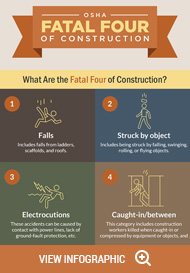
- Slips and falls are among the most common (and dangerous) workplace accidents. These include falls from heights, such as from ladders or scaffolds, as well as slip-and-falls while on ground level. Head injuries are common in these types of accidents, and traumatic brain injuries can seriously alter the rest of a person's life.
- Struck-by accidents is a general category that includes things like falling debris, flying debris, or contact with moving vehicles. These accidents can mostly be prevented by workers being aware of where other people are around them on a jobsite and always keeping control of tools and equipment.
- Caught-in-between accidents include events such as being caught between a loading dock and a semi-trailer, or being in a trench collapse. Such accidents can cause broken bones, serious internal injuries, and suffocation. Most caught-in-between accidents can be prevented by following safety standards regarding proper trenching and behavior around large machinery and vehicles.
- Defective equipment accidents are typically caused by equipment that has not been regularly maintained and kept in a safe condition. There are clear guidelines on how machinery and equipment should be maintained, including how often they should be inspected and how repairs should be performed. Proper lockout/tagout protocols are important for this kind of work to keep everyone safe.
- Lack of personal protective equipment, such as gloves, goggles, steel-toed shoes, hard hats, and ear protection. More specific safety equipment, like personal fall arrest systems (PFAS) and shoring in trenches, is also extremely important to prevent accidents and injuries.
OSHA Safety Rights for All Workers
If you believe that your workplace is unsafe, you are entitled to OSHA protections. OSHA recommends talking to your employer first, but if you are ignored or conditions do not improve, you may file a complaint with OSHA. Call OSHA at 800-321-OSHA or file your compliant online. You can also download the complaint form, fill it out, and fax or mail it to OSHA.
Whenever a worker files a complaint, OSHA will contact the employer to resolve the issue and they may conduct an on-site inspection. If OSHA performs an inspection, workers have the right to be present, speak privately with the inspector, and be included in OSHA meetings with their supervisors. Employers may be issued a citation if they are found in violation of OSHA standards, and employees have the right to be informed about the results of an inspection.
OSHA requires that workers receive regular health and safety training necessary to protect against workplace accidents and injury. Such training must be provided in a language the worker understands. Every worker has the right to work on machines that are safe and be provided with all necessary safety equipment, such as gloves, goggles, harnesses, and lifelines. Workers also have the right to be always protected from hazardous chemicals.
According to OSHA mandates, workers are allowed to report any injury or illness. Employers are also required to provide a worker with a copy of their medical records upon request and to receive copies of all work-related illnesses and injuries.
Protection from Retaliation
Workers have the right to file a complaint with OSHA about hazardous worksite conditions without fear of retaliation. That means a worker cannot be subject to negative consequences for complaining to OSHA. They may not be fired for making the report, and any type of transfer, demotion, or negative workplace consequence is not permitted. Any worker who believes they have been subjected to retaliation for filing an OSHA complaint has 30 days to file a whistleblower complaint.
The Role of Workers' Compensation
Under the New York workers' compensation system, employers are required to provide insurance coverage for their employees. The system is in place to make sure injured employees receive fixed compensation amounts for job-related injuries and illnesses without having to prove fault in court. No matter what caused an accident, an injured or sick worker is covered by workers' compensation so long as the injury or illness occurred while on the job and the worker was not intoxicated or under the influence of drugs.
Even so, some workers' compensation insurers prefer to deny claims to increase profits. Fortunately, workers have recourse in these situations and can appeal a denied claim. The process is not always simple, which is why an experienced workers' compensation attorney is so important. A lawyer can help you with filling out paperwork, filing by necessary deadlines, and represent you when appearing before an appeal review board.
Other Locations We Serve in New York
Contact an Experienced Workers' Compensation Attorney in New York City
At the New York City construction site accident law firm of Wingate, Russotti, Shapiro, Moses & Halperin, LLP, we know that workers' compensation may not sufficiently compensate injured workers. Insurers may attempt to pay only a portion of your medical or deny your claim completely. If that happens, you deserve to have an experienced workers' compensation attorney to represent you. Call us today at (212) 986-7353 and let us fight for you.
Additional Information
- How NYC’s Affordable Housing Push in 2025 Is Risking Construction Worker Safety
- Are New York’s Site Safety Managers Actually Protecting Construction Workers?
- Dangers and Safety Tips for NYC Concrete Workers
- DOB Makes “Zero-Tolerance” Safety Sweeps Following Numerous Construction Deaths
- New York State Division of Safety and Health

The NYC Law Firm Winning Construction Accident Cases
With 50 years of winning construction accident cases, you can be sure that when you choose Wingate, Russotti, Shapiro, Moses & Halperin, LLP you're choosing a firm with a deep reservoir of knowledge and experience.